The SEO industry has an advice problem. Not a shortage: a flood. Open any group, any feed, any community, and you'll find confident, contradictory advice on every topic. Links matter, links don't matter. AI content is fine, AI content is poison. Niche sites are dead, niche sites are back.
After a decade-plus in this industry, and a few years of teaching thousands of people inside it, I've landed on one filter that cuts through almost all of it.
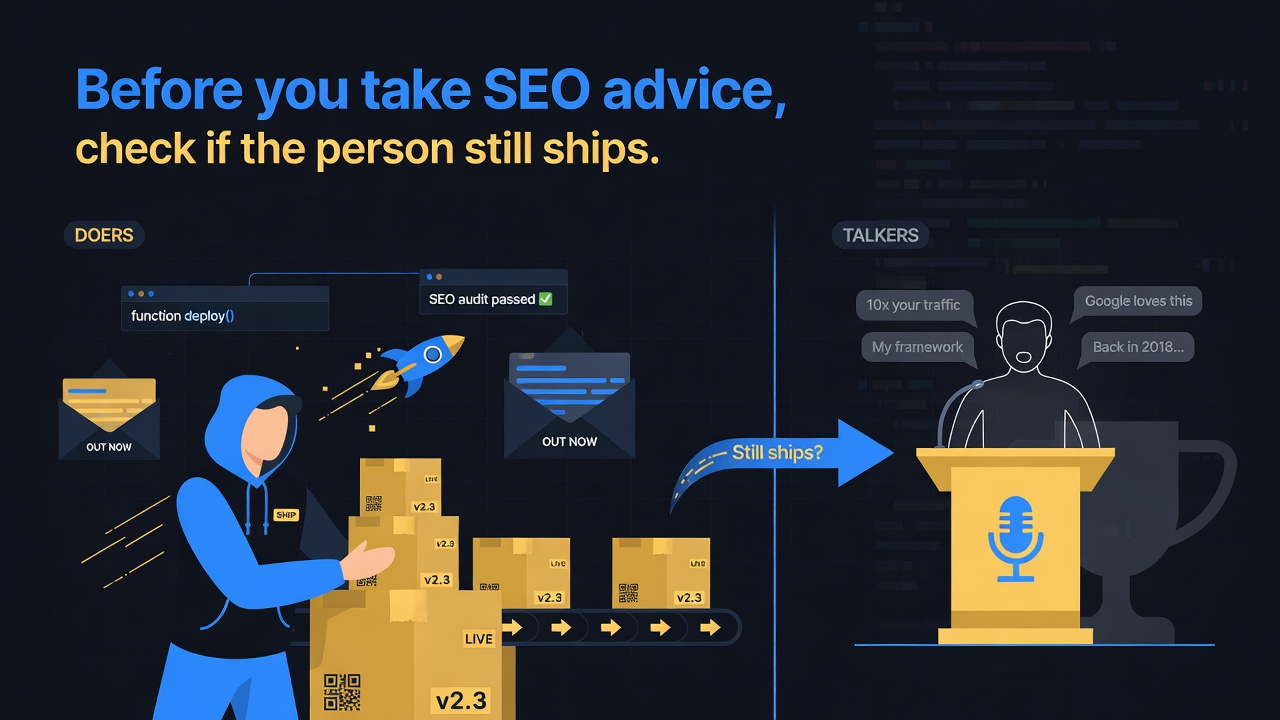
Before you take anyone's SEO advice, ask one question: does this person still ship?
What I mean by shipping
Shipping means doing the actual work, currently, with their own money or reputation on the line. Building sites that have to rank. Running campaigns that have to convert. Writing software that has to work. Putting a thing into the world where reality, not an audience, grades it.
Notice what's not on that list. Posting isn't shipping. Having a big following isn't shipping. Having ranked a site in 2017 isn't shipping. Even teaching isn't shipping, by itself, and I say that as someone who teaches. Teaching is only worth listening to when there's current work behind it.
The reason this filter works is simple: SEO punishes outdated knowledge faster than almost any field. Google changes constantly. What worked three years ago can be neutral now, or actively harmful. The person who stopped doing the work didn't stop learning on purpose; the field just moved and they didn't move with it, because nothing they ship forces them to.
Reality is the only teacher in this industry that never goes out of date. Shipping is how you stay enrolled.
The tells
You usually can't audit someone's client list, but secondhand advice has a smell. A few tells I watch for:
Their examples have no dates. People doing current work cite current results, with specifics: this niche, this timeframe, this outcome. People running on old knowledge speak in evergreen generalities, because their specifics would reveal their age.
Everything works. Someone who actually ships has scars. They'll tell you what failed, what they abandoned, what they got wrong last quarter. I've explored integrations and features that went nowhere, and killed them without drama; anyone doing real work has a graveyard. The advice-giver whose every strategy succeeds has either never tested them or isn't telling you the truth.
They can't show you, only tell you. Ask someone to walk through their actual process and watch what happens. The practitioner opens a screen and starts clicking, because the process lives in their hands. The reciter gives you a framework with a clever acronym and gets vague the moment you ask what button they press next.
Their advice never costs them anything. Real practitioners give advice that occasionally points away from their own offer, because reality is more complicated than their product line. If every road leads to the checkout, you're not getting advice. You're getting routed.
They argue from authority, not from results. "I've been doing this for 15 years" is not evidence. The field reset itself at least three times in those 15 years. "Here's what happened when I did this in March" is evidence.
Why teaching makes this worse, not better
Here's an uncomfortable truth about my corner of the industry: education has better margins than doing. Selling courses about ranking sites is easier than ranking sites. So the natural drift, for anyone who finds an audience, is away from the work and toward the talking.
I watch for that drift in myself, and I'll tell you the mechanism I use, because I think it's the only honest one: I do my teaching live.
Twice a month I run webinars where people watch me do the actual work. Pick a niche, check the competition, build the site, optimize it, on screen, in real time. No edit button. When something breaks, 700 people watch it break, and then they watch me figure out why. In 2025 I launched a new product feature live on stage at a conference in Phoenix, with a hard deadline and no fallback, for the same reason.
I'm not telling you this to position live teaching as the only valid format. I'm telling you because it's the test I volunteered for, and I think anyone selling SEO education should be able to point at their version of it. Where does reality get to grade them in public? If the answer is nowhere, the polish on their content is doing a lot of work.
Run the filter on me
Fair is fair. If you apply this filter to the people you currently learn from, apply it to me too.
I build SEO software for a living: a platform my own projects run on, plus eleven more apps that exist because I hit walls in my own work. Every feature was tested on my sites before anyone else saw it; if it doesn't survive my own projects, it doesn't ship. The methods I teach are the same ones in the software, which means when they stop working, my business breaks before my curriculum does. That's not virtue. That's just exposure, and exposure is what keeps advice honest.
Could I still be wrong about things? Constantly. Anyone shipping is wrong on a regular schedule; that's what the scars are. But you'll be hearing this month's mistakes, not 2019's greatest hits.
What to do with this
Next time you're about to act on a piece of SEO advice, run the check. Look for dates on the examples. Look for the graveyard. Ask to see the process, not the framework. Notice whether the advice ever costs the giver anything.
And when you find people who pass the filter, hold onto them, even when their advice is less exciting than the loud stuff. Practitioners tend to sound boring next to performers, because reality is less dramatic than content. "It depends on the competition in your niche" doesn't go viral. It's also usually the truth.
The industry's flood of advice isn't going to slow down. AI just made producing confident content nearly free, so the noise gets louder from here. The filter is how you keep your footing: not who sounds smartest, not who's biggest, but who still ships.
It's a short list. It's the only list worth being on.